Servo and Pneumatic Task Division in Vertical Baggers
A machine-design guide to assigning film indexing to controlled motion and using pneumatics for clamping, bag opening, sealing jaws, and qualified short strokes.
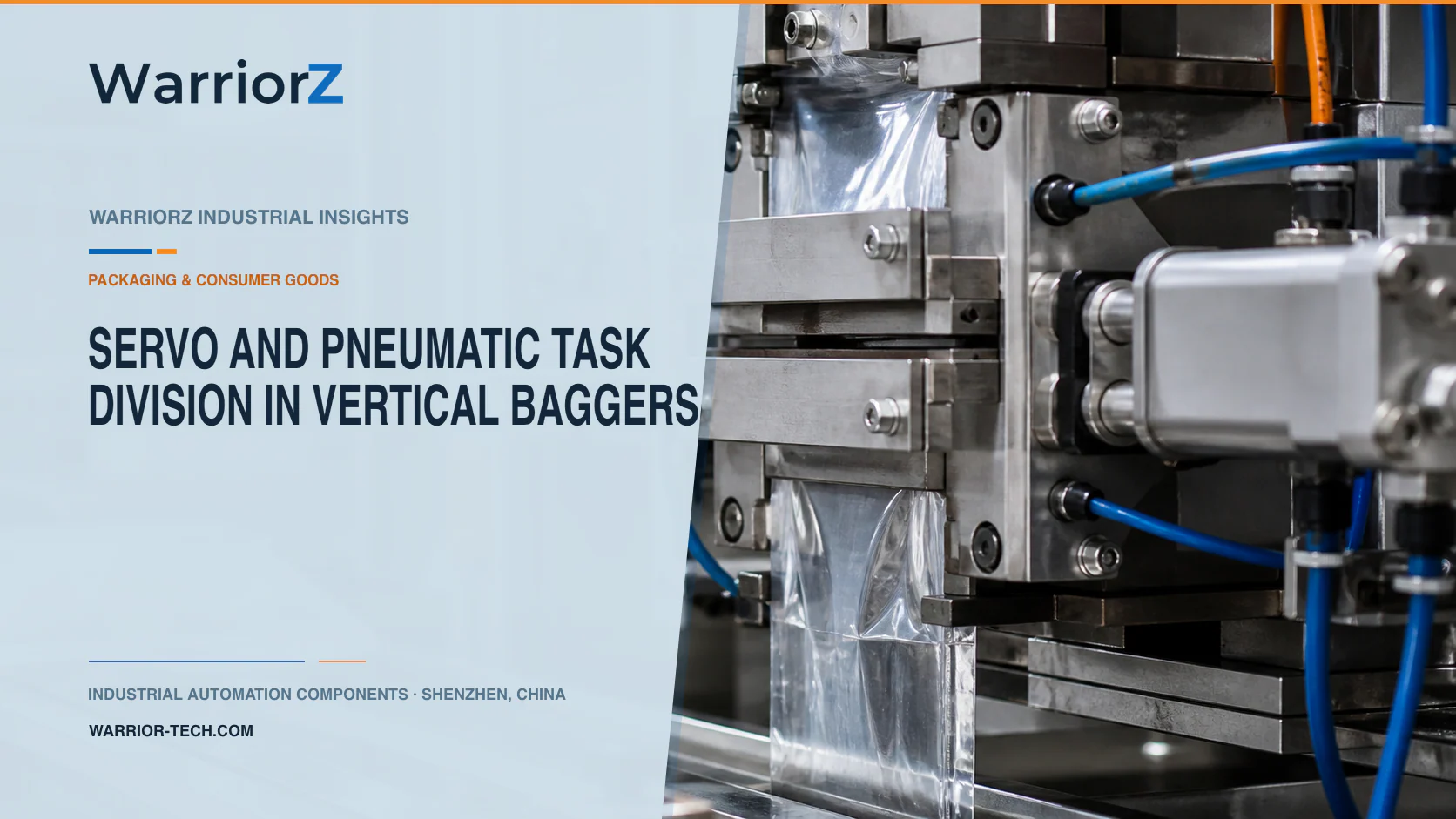
A vertical form-fill-seal machine unwinds packaging film, controls tension, forms a tube or opens a premade bag, meters product, seals the package, and cuts or transfers it. Servo motion should own film length and registration when the machine needs precise indexed pulling. Pneumatics can clamp film, open a bag, move sealing jaws, divert rejects, and perform other short-stroke tasks that have qualified force and timing windows.
WarriorZ supports maintenance and automation teams with pneumatic spare-part identification, product matching, and international supply. The OEM owns the machine architecture, sizing, software, safety functions, hygienic design, and compliance. The factory owns film, product, seal, food-safety, cleaning, recipe, inspection, and package-release requirements.
Assign each task to the right motion technology
Start with the process requirement, not an actuator preference. Film pulling needs controlled distance, acceleration, tension, registration correction, and coordination with unwind and forming. A servo or other controlled motion system can execute that trajectory and report position. A cylinder is better suited to moving between defined mechanical states when its speed, force, and timing can vary within a qualified range.
Machine task | Preferred control owner | Reason | Required proof |
|---|---|---|---|
Film index to length | Servo or controlled film drive | Position and registration define bag length | Encoder and mark-tracking result |
Film clamp | Pneumatic gripper or clamp | Short hold and release action | Closed state and no film damage |
Bag opening | Pneumatic gripper or vacuum device | Defined open and close states | Bag-open confirmation |
Sealing jaw closure | Guided pneumatic or controlled axis | Load and travel follow a process window | Position, load proxy, and seal result |
Product dosing | Dedicated filler control | Product quantity is not a clamp task | Dose and package identity |
Reject diversion | Pneumatic gate when suitable | Short binary routing motion | Reject and gate state tracking |
Do not use a cylinder as a low-cost substitute for precision film indexing when the product requires registered length. Cylinder end positions can repeat while film stretches, slips, or wrinkles. Keep film-drive and pneumatic state machines coordinated through explicit permits and fault states.
Define film handling from unwind to seal
Record film material, thickness, width, coefficient of friction, stiffness, sealant layer, registration marks, roll diameter, splice method, forming geometry, tension limits, seal window, and static behavior. Include temperature and humidity conditions that the packaging owner has approved.
The servo drive should pull against controlled unwind and forming resistance. Pneumatic clamps should hold without pinching through the film or leaving a mark that weakens the seal. Shape clamp faces and jaw surfaces for the film and keep them parallel. A pressure setting cannot correct a twisted forming collar, worn belt, or misaligned jaw.
Locate tubing, valves, and sensors away from hot jaws and film scraps where possible. Measure the actual environment before selecting materials and protection. Custom brackets, cable entries, and connectors can reduce the protection of an otherwise suitable component.
Coordinate the cycle through verified states
Build a state sequence around material and machine position. Confirm film path and tension before indexing. Confirm index completion and seal-zone clearance before closing jaws. Confirm jaw opening before the next pull. Confirm bag opening before dosing, and confirm dosing complete before final seal closure.
Cycle state | Entry condition | Pneumatic action | Inhibit condition |
|---|---|---|---|
Film ready | Web threaded and tension valid | Release film clamp as designed | Broken web or wrong recipe |
Index | Jaws and clamp clear | Hold bag features that must remain fixed | Jaw not open or film path blocked |
Bag open | Index and cut state complete | Open grippers or vacuum device | Bag-open proof missing |
Fill | Bag positioned and supported | Maintain approved hold | Wrong product or filler fault |
Seal | Product clear of seal area | Close guided jaws at qualified force | Wrinkle, contamination, or obstruction |
Cut and release | Seal process complete | Open jaws and release bag | Knife or jaw state disagreement |
Timers can enforce dwell and detect late motion. They should not prove that film stopped, a bag opened, or a jaw cleared. Preserve servo position, registration, clamp, jaw, pressure, filler, and inspection data around a fault.
Control clamping and jaw force by recipe
Define a lower clamp load that prevents film slip and an upper load that avoids embossing, thinning, cutting, or permanent deformation. For sealing jaws, characterize the relationship among pneumatic pressure, jaw area and linkage, friction, back pressure, thermal expansion, jaw parallelism, and real closure force.
Festo's VPPM proportional-pressure regulator data lists product-specific pressure range, flow, accuracy, response, interfaces, and environmental data. Use it only after calculating chamber volume, inlet margin, required response, and load. A regulator does not validate seal integrity.
Festo's DFM guided drive data illustrates guide, load, cushioning, sensing, and environment parameters for a guided pneumatic axis. Use it as selection evidence for that product family, not as a default jaw design. The OEM must calculate jaw mass, offset, thermal effects, loads, duty, and service life.
Protect recipes that bind film drive, clamp pressure, jaw pressure, temperature, dwell, cooling, and product dose. After film, jaw, heater, cylinder, regulator, or software changes, repeat the affected package validation.
Keep seals clean and product out of the jaw
Product in the seal area creates leaks and can damage a jaw. Coordinate dosing, settling, vibration, dust extraction, and bag support so the seal zone clears before closure. Use inspection appropriate to the product risk. Jaw position alone cannot detect every trapped particle or wrinkle.
Define cleaning and contact materials with the factory's food-safety team and machine OEM. Pneumatic catalog compliance does not establish food-contact suitability for the jaw, gripper, tubing, exhaust location, or complete machine. Route exhaust away from open product and the inside of the package.
Film scraps and product dust can enter guides, sensors, and silencers. Provide collection and inspection access. Do not blow contamination through the machine when that could spread allergens, combustible dust, product, or packaging fragments.
Manage heat, static, and risk-assessed stops
Hot jaws, cutters, clamps, grippers, film drives, and stored compressed air create combined hazards. ISO 12100:2010 provides the machinery risk-assessment framework. ISO 4414:2010 addresses pneumatic-system hazards and system life-cycle considerations. Festo's industrial packaging overview provides first-party packaging automation context without replacing a machine-specific design.
Decide the risk-assessed state for loss of power, air, heat control, film tension, or servo control. Opening a hot jaw may expose an edge or release unsupported film. Keeping it closed may preserve a crush hazard or burn product. The required stop sequence can vary by machine phase, so document and validate it.
Static can disturb film tracking and bag opening. Assess grounding, ionization, material compatibility, humidity, and cleaning with the real film. Pneumatic exhaust does not control static and may destabilize a light web.
Process sensors and motion feedback are not safety functions by default. The OEM must define guards, safety controls, reset logic, and validation. The factory must isolate electrical, pneumatic, thermal, gravity, spring, and cutting energy before threading film, clearing product, or servicing jaws.
Commission the complete package window
Run each approved film, product, bag size, dose, roll condition, speed, registration, temperature, seal, clamp, and supply extreme. Inspect bag length, print registration, wrinkles, opening, fill, contamination, seal width and continuity, cut, leak performance, appearance, and downstream handling.
Challenge a film break, splice, mark loss, servo position error, clamp slip, bag-open failure, wrong dose, product in seal, low supply, pressure drift, restricted exhaust, jaw obstruction, heater fault, knife disagreement, static cling, downstream backup, and interrupted cycle. Do not restart from an uncertain bag or film position.
For a related vacuum timing application, see vacuum pickup and pneumatic pressing for carton labels. For a component review based on the machine's task allocation and package window, send a WarriorZ vertical-bagger inquiry.
Official sources
Sources and verification basis
These references support the documented facts, calculations, or engineering boundaries used in this article.