Pneumatic Bag Shaping Before Palletizing
A practical guide to setting plate pressure and dwell, protecting bag seals, coordinating with the palletizer, and detecting abnormal packs or foreign objects.
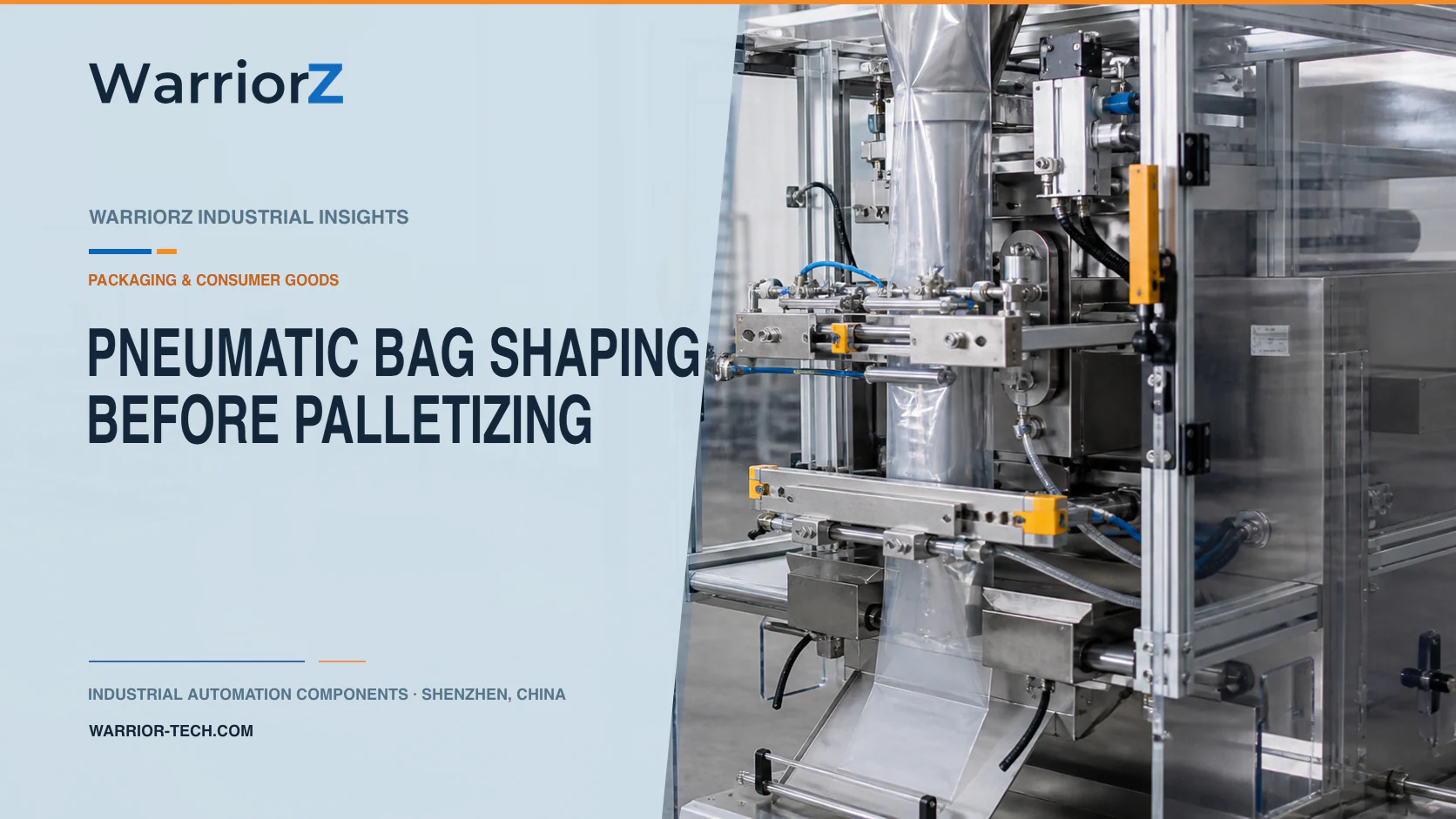
A bag flattening station sits between filling or case handling and robotic or conventional palletizing. Upper and lower plates briefly reshape each bag so it presents a stable footprint, controlled thickness, and predictable center of mass. The pneumatic system must improve stackability without rupturing a seal, grinding product against the film, or trapping a foreign object.
WarriorZ provides BOM review, product matching, and sourcing support for documented pneumatic applications. The OEM owns the machine, pressure and load calculations, controls, guards, and integration. The food factory owns the bag and seal specification, product quality limits, hygiene, foreign-object controls, operating recipes, and final pallet acceptance.
Define the palletizing problem in measurable terms
Do not add a flattening press because bags look uneven. Define the downstream failure: unstable stack, variable layer height, gripper miss, bag overlap, exposed corner, center-of-mass shift, or load protrusion. Establish the bag geometry that the palletizer can handle and the seal condition that must remain unchanged.
Record bag material, dimensions, fill mass, fill volume, headspace, product particle size, flow behavior, seal type, seal location, residual air, temperature, and allowable compression. Powders, granules, chips, and frozen products redistribute differently. A recipe that levels one product can create a hard lump or stress the seal of another.
Product input | Why it matters | Factory evidence |
|---|---|---|
Fill mass and volume | Set bag thickness and internal pressure | Filling records and approved range |
Product flow behavior | Controls redistribution under load | Representative bag trials |
Headspace and trapped air | Affect peak pressure and rebound | Seal and venting assessment |
Seal design | Defines no-contact and load limits | Packaging validation data |
Film temperature | Changes stiffness and seal strength | Warm and cold production trials |
Pallet pattern | Defines target footprint and layer height | Palletizer and transport requirements |
Use guided plates and controlled contact
Keep the upper plate parallel to the support surface over the qualified bag range. Use guides designed for the plate mass, offset load, and product reaction. Large-bore cylinders may provide the required force, but their mounting and structure must distribute it without bending the plate.
Shape plate edges so they do not pinch film. Avoid pressing directly on the seal unless the packaging owner has qualified that contact. A compliant facing can spread load and protect print, while too much compliance can hide a foreign object or concentrate pressure at a worn edge.
Provide drainage and cleanability suitable for the plant. Select facing, lubricants, finishes, and fasteners from food-safety and sanitation requirements. A pneumatic component catalog does not establish food-contact approval for custom tooling.
Establish a pressure and dwell window
The lower boundary is the least load and dwell that produces the required palletizing geometry. The upper boundary comes from seal integrity, film strain, product damage, trapped-air pressure, and plate or bag displacement. Characterize the relationship between regulated pressure and real plate load across travel.
Festo's VPPM proportional-pressure regulator data lists product-specific range, flow, accuracy, hysteresis, response, interface, and environmental information. Use it as a selection reference after calculating cylinder area, chamber volume, required response, inlet margin, and exhaust. The regulator does not measure bag seal stress or finished shape.
Trial variable | Qualified range | Measure during trial | Reject indicator |
|---|---|---|---|
Compression load | Recipe-specific low to high boundary | Pressure and characterized plate force | Seal strain or product damage |
Dwell | Normal cycle and credible stop | Time at load and bag recovery | Permanent deformation or leakage |
Bag position | Centered and allowed offset | Plate contact and edge clearance | Film caught at plate edge |
Product distribution | Normal and worst approved fill | Final footprint and thickness | Hard lump or uneven layer |
Temperature | Production minimum and maximum | Film and seal condition | Cracking, creep, or weak seal |
Supply condition | Approved inlet extremes | Pressure response and motion | Slow, unstable, or incomplete cycle |
Bind pressure, approach speed, plate position, and dwell in one controlled recipe. Restrict overrides and record changes. When two bag families have incompatible force windows, use separate recipes or reject the wrong product rather than using a broad compromise.
Coordinate the station with the palletizer
Confirm one bag is centered, the lower support is ready, and the discharge path is clear before lowering the plate. Approach at a controlled speed, prove a plausible contact state, apply the qualified load and dwell, then unload before transferring the bag.
The palletizer should receive a bag only after the plate reaches a clear position and the station confirms product identity and outcome. If the robot relies on a height or vision measurement, take it after the bag has completed the defined recovery interval. Measuring under load gives the wrong geometry.
Handle downstream backup explicitly. Holding a bag under pressure until the robot clears changes dwell and may damage the seal. Release to a safe support position or stop before pressing, according to the validated sequence.
Detect foreign objects and abnormal bags
Use upstream inspection and position sensing to identify doubled bags, folded seals, torn film, misplaced labels, tools, and hard foreign objects. A pressure rise or early position stop can support detection, but thresholds must account for normal product variation.
Do not continue increasing pressure when the plate meets resistance early. Stop and preserve the signals. An object between the plate and bag can puncture the film or become a projectile when released. Define a guarded, isolated recovery method.
Inspect leaking or burst bags under the factory's product-hold and sanitation process. Loose food can enter guides, valves, sensors, and nearby packs. Avoid clearing it with compressed air where that would spread product, allergens, dust, or fragments.
Protect people from the press and stored load
The upper plate, lower support, stops, conveyor, and transfer mechanism create large crush and trapping zones. OSHA's machine guarding general requirements describe protection around points of operation and moving parts. ISO 12100:2010 provides the general machinery risk-assessment framework, and ISO 4414:2010 addresses pneumatic-system hazards.
Determine the safe state for air loss, power loss, a guard opening, bag rupture, plate jam, and robot stop. Venting can allow a heavy upper plate to descend. Trapped air can hold a plate and then release when the obstruction moves. Provide mechanical restraint where the risk assessment requires protection beneath a raised plate.
Process pressure and position sensors are not safety devices by default. The OEM must design and validate safety functions, reset behavior, guards, and energy isolation separately. The factory must verify isolation before cleaning, retrieving a bag, or entering the press space.
Validate bag families and pallet outcomes
Run each approved product, bag, fill range, seal condition, temperature, orientation, line speed, supply condition, and pallet pattern. Measure final footprint, thickness, rebound, seal integrity, leakage, print or film damage, robot pickup, layer stability, and transport outcome.
Challenge a missing bag, double bag, off-center bag, folded seal, low fill, overfill, leaking pack, foreign object, wrong recipe, pressure drift, low supply, restricted exhaust, cylinder leak, plate misalignment, robot backup, and interrupted cycle. A recovered bag should be rejected or re-inspected when its load history is uncertain.
For another packaging motion where product stability and impact limits control the design, see side-push carton packing and bottle-tipping risk. For a pressure and dwell review based on filled sample bags, send a WarriorZ bag-flattening inquiry.
Official sources
Sources and verification basis
These references support the documented facts, calculations, or engineering boundaries used in this article.