Synchronizing Pneumatics in Shrink Wrapping Machines
A practical guide to coordinating pack restraint, film feed, sealing jaws, and cutting motion while controlling product pressure, heat exposure, static, and faults.
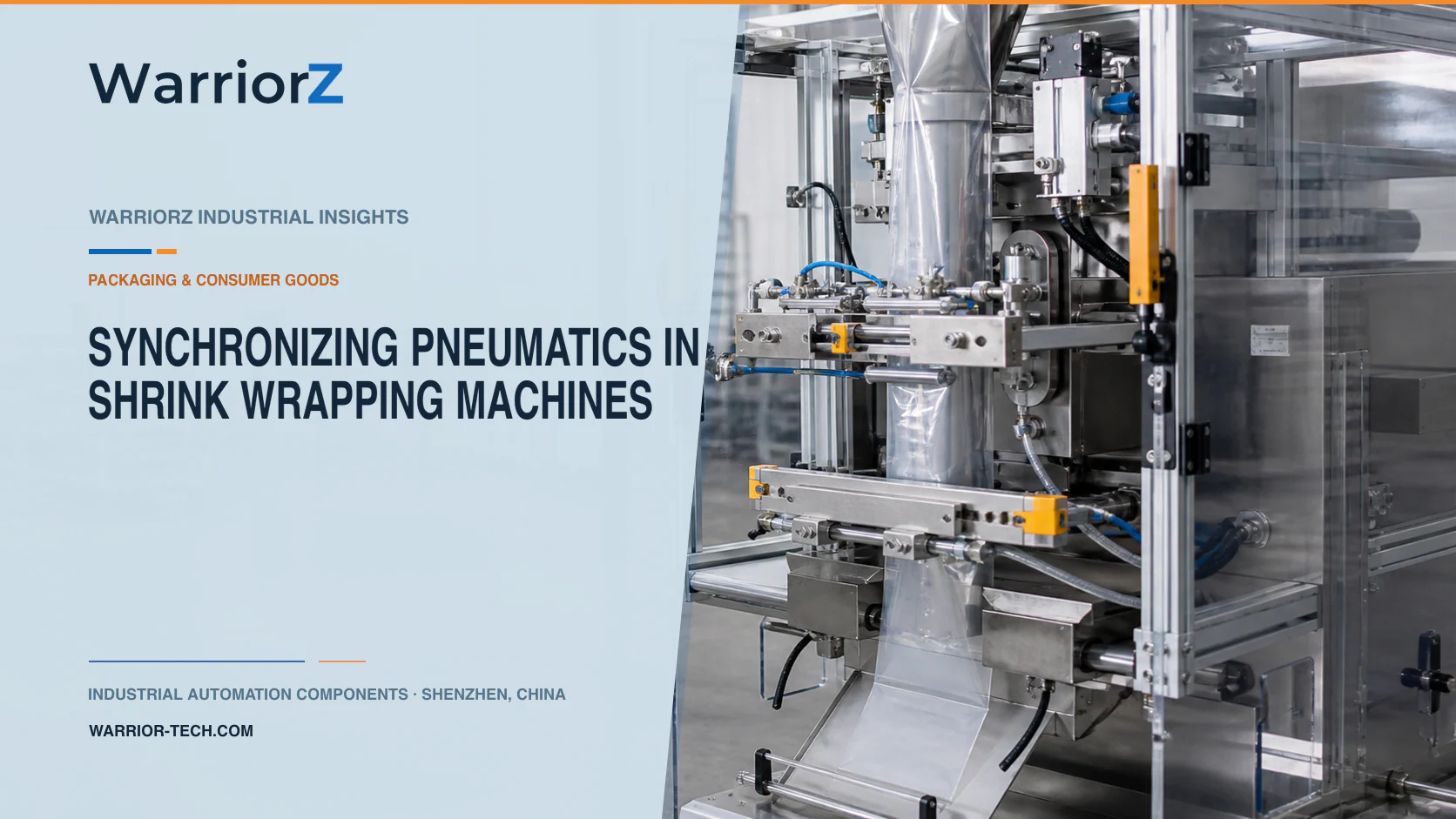
A shrink wrapping machine groups products, stabilizes the pack, presents film, closes a sealing or cutting assembly, separates the film, and transfers the pack into a heat zone. Pneumatic clamps and cylinders suit short, repeated positioning tasks, but the product restraint and knife must follow the film-feed and conveyor states with clear interlocks.
WarriorZ supports documented pneumatic requirements with component comparison, sourcing, and delivery coordination. The OEM owns the mechanism, pneumatic sizing, electrical and safety controls, guards, and heat-zone integration. The factory owns product and film specifications, sealing settings, operator procedures, maintenance, and final pack acceptance.
Define the film and pack states
Map the process from product accumulation through seal cooling. Record pack length, width, height, compressive strength, surface friction, grouping method, film material, thickness, roll width, tension range, seal method, and line speed. Film behavior changes with storage, static, temperature, and roll condition.
Use physical states such as group complete, pack restrained, film at length, seal area clear, jaws closed, seal energy complete, knife returned, and transfer permitted. A timer can enforce a process dwell, but it should not replace proof of knife position or guard state.
State | Pneumatic duty | Required coordination | Failure to prevent |
|---|---|---|---|
Product grouping | Stop or press the pack | Conveyor count and pack position | Loose or doubled group |
Film presentation | Hold film or switch a guide | Film drive and registration | Wrinkle or short film |
Jaw approach | Move sealing and cutting assembly | Product clear and film stopped | Product strike |
Seal and cut | Maintain qualified closure | Seal energy and knife sequence | Open seal or uncut film |
Jaw opening | Clear film path | Knife returned and heat state known | Film snag or exposed blade |
Pack transfer | Release restraint | Downstream heat tunnel available | Collision or film pullback |
Stabilize the product without crushing it
The press or side guide should control pack geometry before the film is cut. Establish its contact area, travel, and force from the weakest approved package. Bottles, cartons, tissue bundles, and flexible containers need different restraints. A high setpoint may make the machine appear stable while denting primary packs or distorting labels.
Characterize a lower force that prevents product movement and an upper force that preserves the pack. Include line stop dwell, since a cylinder may remain loaded while a downstream heat tunnel clears. Use mechanical guidance and broad contact plates. The cylinder rod should not carry side moments from a wide beam without a guide.
Record actual pressure and position when process risk justifies it. These signals show actuator behavior. They do not prove that every primary package remained undamaged, so retain product inspection in the qualification plan.
Keep the knife on a guided, guarded path
The film knife or sealing jaw needs resistance to rotation and side load. Festo's DFM guided drive data lists product-specific guide, load, sensing, and cushioning information. Use it as one engineering reference, not a selection decision. The OEM must calculate the real jaw mass, offset load, thermal exposure, cycle rate, bearing contamination, and stop forces.
Keep pneumatic seals, tubing, switches, and valve manifolds outside the hot zone when practical. Use thermal barriers and approved materials where exposure remains. Heat can change lubricant, elastomer, sensor, and cable performance. Verify each component's declared environment against measured machine conditions.
The cutting element must return to a proven protected position before normal access or film threading. A cylinder retracted signal confirms actuator travel at its sensor location, not the absence of a broken blade or stuck linkage. Inspection and maintenance controls remain necessary.
Coordinate the clamp, film drive, and jaw
Let the film drive establish length and tension. Use pneumatic motion to clamp, present a guide, or close the jaw where the mechanism and required control suit it. Do not use a closing cylinder to correct uncontrolled film-feed length.
Event | Permit condition | Monitored result | Fault response |
|---|---|---|---|
Clamp pack | Correct group at seal station | Restraint reaches qualified state | Hold film and conveyor |
Stop film | Registration or length complete | Film motion stopped | Inhibit jaw |
Close jaw | Seal zone clear | Closed position within window | Stop before seal energy if possible |
Apply seal energy | Qualified closure present | Process time and temperature recorded | Open only through defined fault sequence |
Cut film | Jaw and knife sequence valid | Knife travel complete | Prevent transfer on disagreement |
Release pack | Jaw and knife clear | Product exits and film remains controlled | Stop upstream on backup |
Tune air flow under normal and adverse supply conditions. A restricted exhaust or worn guide can delay jaw opening and cause the film drive to pull against a partly closed tool. Preserve command, pressure, position, film, and conveyor signals around a fault so maintenance can identify the actual sequence break.
Control static, scraps, and seal contamination
Film static can pull a web toward the knife, attract dust, or make loose tails cling to a guide. The factory and OEM should assess film-specific static controls, grounding, ionization, humidity, and compatible cleaning. Do not assume pneumatic exhaust removes static. An air jet may spread scraps or disturb the film edge.
Extract or collect trim where the process produces it. Detect a growing scrap ball before it enters a linkage. Keep sealing faces and knife supports clean to the film supplier's and machine builder's instructions. Residue can create a weak seal while every cylinder signal remains normal.
Use a released film and product trial to establish jaw force, seal energy, cooling time, and knife condition. The pneumatic circuit supplies motion or force. It does not determine whether a package seal meets the product's integrity requirement.
Separate normal stops from safe access
The machine contains crush points at the restraint and jaws, a cutting edge, hot surfaces, conveyors, stored compressed air, and possibly a heat tunnel. ISO 12100:2010 provides general risk-assessment principles. ISO 4414:2010 covers pneumatic system hazards through relevant life-cycle stages. OSHA's machine guarding overview describes guarding needs around points of operation and moving parts.
Define a risk-assessed state for loss of power, air, heat control, or film tension. Immediate jaw opening may expose a hot or sharp element. Keeping it closed may preserve a crush hazard or damage the film. The OEM must decide and validate the sequence for each phase.
Process sensors are not safety components by default. Design safety functions, protective devices, reset logic, and validation separately. Before clearing film, changing a knife, cleaning a jaw, or servicing a cylinder, isolate hazardous energy and verify the isolated condition.
Qualify packs, films, stops, and faults
Run every approved product group and film at relevant package strength, surface, temperature, roll diameter, film tension, line speed, jaw temperature, tool wear, supply, and ambient conditions. Inspect product damage, film length, wrinkles, seal continuity, cut quality, pack appearance after the heat tunnel, and rework rate.
Challenge a missing product, incomplete group, wrong film, registration loss, film break, static cling, pack skew, low supply, restricted exhaust, cylinder leak, jaw obstruction, knife return failure, temperature fault, tunnel backup, and interrupted seal. Do not restart automatically when film or product position is unknown.
For the downstream case-closing application, see adaptive pneumatic beams for random case sealers. For a component review based on the actual pack and film cycle, send a WarriorZ shrink-wrapper inquiry.
Official sources
Sources and verification basis
These references support the documented facts, calculations, or engineering boundaries used in this article.